
When it was sent, when it arrived
Each reading is stored with the time the network received it from the sensor and the time it reached our platform, in UTC.
How Smart Monitor data supports a CPR Part 35 expert report, the Housing Ombudsman’s call to know your homes, and Awaab’s Law. Written for legal, disrepair, surveying and compliance teams.
Yes, as evidence an expert relies on.
CPR Part 35 sets rules for expert witnesses and their reports, not for devices, so no sensor is “CPR 35 compliant” on its own. What matters is whether an expert can rely on the data. Smart Monitor records the facts, methods and timings that Practice Direction 35 asks an expert to set out. Whether and how the data is relied on is for the expert and the court.
See what the expert getsDamp and mould disputes often reach the county court, where CPR Part 35 governs the experts both sides rely on. An expert’s report must say what it relied on. This is what Smart Monitor gives them.
Each reading is stored with the time the network received it from the sensor and the time it reached our platform, in UTC.
A fingerprint of each damp and mould evidence pack’s content is printed on every page and logged when it is made.
Three years live, then archived. Never removed while an Awaab’s Law case is open.
No resident, occupant, health or vulnerability data appears in an evidence pack.
Under CPR Part 35 an expert’s overriding duty is to the court, and the opinion is theirs. Smart Monitor supplies a factual record of conditions in the home. It does not replace the expert’s own inspection, judgement or report. Sources: Civil Procedure Rules Part 35 and Practice Direction 35.
A damp and mould evidence pack is a dated PDF for one property, produced on request. It brings the readings, the case and the method together in the order an expert or surveyor would read them.
Property data only. No resident, occupant, health or vulnerability data.
The current risk band, peak risk and when it occurred, and how long conditions have persisted.
Every event by day, with the time it happened, the time it was recorded, the sensor and who acted.
Surface condensation risk under BS EN ISO 13788 and the VTT mould index, with time to onset.
The Awaab’s Law clocks as they stood when the pack was requested, with the HHSRS and fitness position.
Recommended actions, observations, photos and the property notes at the time.
Every standard, model and threshold used, each labelled as a standard, a model or law.
The best evidence is a problem fixed before it becomes a claim. The Ombudsman asks landlords to move from reactive to proactive, with a data-driven, risk-based approach that finds problems before a resident has to complain.
“Knowing your residents and their homes has never mattered more.”
The Ombudsman’s follow-up names “know your stock” as a key factor for boards. A risk-ranked view shows which homes have conditions that lead to mould, and since when.
Alerts reach the right team when humidity, surface condensation or cold persist, so you are not relying on residents to report it.
The Ombudsman says a proactive approach relies on accurate records. Every reading, alert and action is kept in one dated record for each home.
The Ombudsman cites humidity and temperature sensors as good practice in both its damp and mould reports. Sources: Housing Ombudsman, Spotlight on: Damp and mould. It’s not lifestyle (October 2021); One year on follow-up report (February 2023); Spotlight on: Knowledge and information management (May 2023).
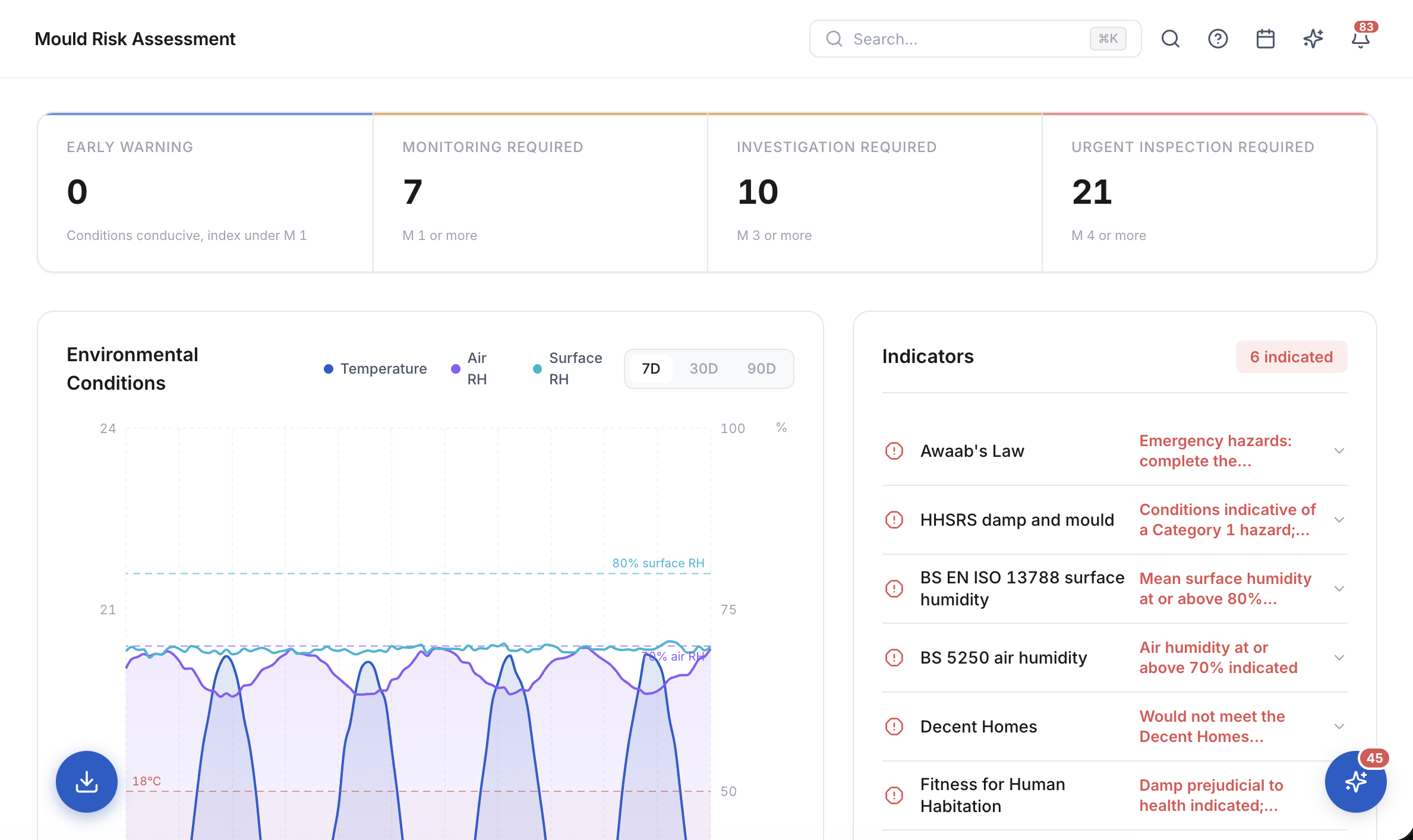
Every monitored property is placed in a band. The first two match the timescales in SI 2025/1042. We never label a home “compliant”: sensors can show the absence of a warning sign, not that a legal duty has been met. Where there are not yet enough readings to judge, the platform says “not yet assessable” rather than guess.
Investigate and make safe.
Investigate a potential significant hazard.
Keep monitoring and review at the next inspection.
Readings show no sign of a hazard.
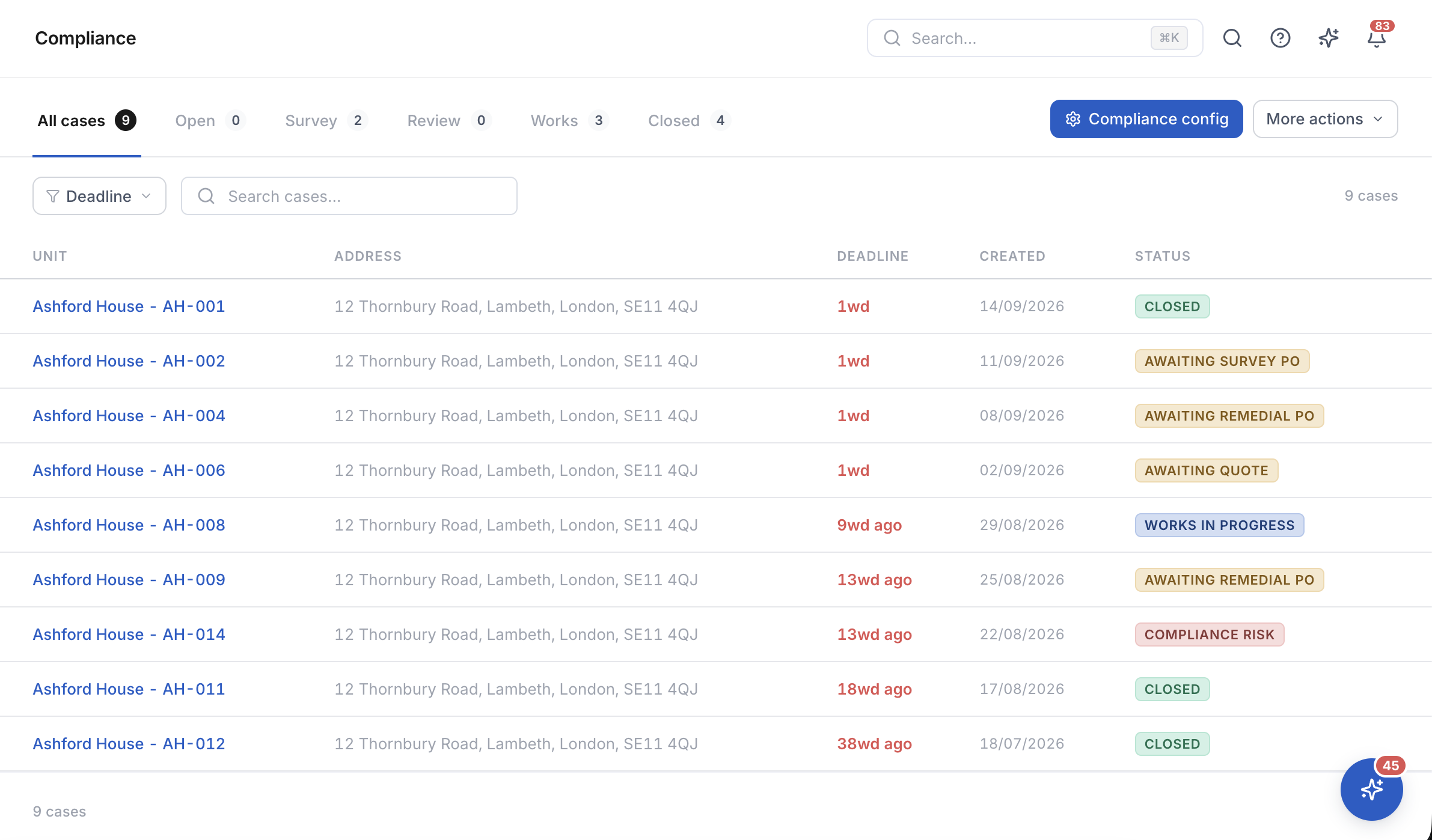
Landlord and Tenant Act 1985 section 10A, inserted by the Social Housing (Regulation) Act 2023, and the Hazards in Social Housing (Prescribed Requirements) (England) Regulations 2025. Evidence packs print the case clocks as they stood when the pack was requested.
Damp and mould growth is hazard profile 11 under the Housing Health and Safety Rating System (Housing Act 2004). Sensor data informs the assessment. The rating itself is made by an assessor, not a sensor.
Landlord and Tenant Act 1985 sections 9A and 10, as amended by the Homes (Fitness for Human Habitation) Act 2018.
Reports flag where a confirmed hazard would mean a home does not meet Criterion E, so it can be planned into your programme.
We label each source for what it is. A British Standard or scientific model guides the calculation; it is not the law. The law sets the duties and timescales.
| What we calculate | Source | Type | Why it matters |
|---|---|---|---|
| Dew point and surface humidity | BS EN ISO 13788:2012 | Standard | Mould grows on the cold wall surface, not in the room air. We estimate humidity at that surface using the building’s thermal factor. |
| Room humidity | BS 5250:2021 | Standard | Sustained high humidity is the main driver of condensation in homes. |
| Mould growth index (0–6) | ASHRAE 160-2021 / VTT mould growth model | Model | Scores whether mould is likely to grow over time, not just whether the air is damp. |
| Excess cold | HHSRS operating guidance | Guidance | Low indoor temperatures are a hazard in their own right and raise condensation risk. |
| Legionella risk | HSE HSG274 / ACoP L8 | Guidance | Water temperature and hours without flow, combined into evidence packs for duty holders. |
| Smoke alarm testing and status | BS 5839-6 | Standard | Tamper, fault, self-test and battery records show an alarm is actually working. The standard sets no self-test interval for connected alarms, so that window is our own rule. |
An expert will ask where the numbers came from. We use commercial LoRaWAN sensors from established manufacturers in Sweden and the UK, and protect every reading from the sensor to the report.
Every message is encrypted with AES-128 before it leaves the device, using keys unique to that sensor.
Gateways relay messages without being able to read them. An altered or replayed message is rejected.
Readings arrive over TLS 1.2 or higher and are stored encrypted on Amazon Web Services in London.
Staff sign in with multi-factor authentication, and each role sees only what it needs.
Sound is sent as a decibel level, never a recording.
Each landlord sees only its own homes. Residents see only their own.
A retention schedule enforced daily. Data is deleted or anonymised within 90 days of contract end.
We act as data processor for the landlord. Data is never sold or used for advertising.
The same dated record serves the people who prevent problems and the people who resolve disputes.
A dated record of conditions in the home, to defend or settle a claim on the facts.
CPR 35 evidenceReadings, named methods and a timeline to cite in a report, alongside your own inspection.
The evidence packRisk bands and Awaab’s Law clocks for every monitored home, with the case history behind them.
Awaab’s LawEvidence that you know your stock and act early, as the Housing Ombudsman asks.
Know your homesCPR Part 35 applies to expert witnesses and their reports, not to equipment. Smart Monitor is built so an expert can rely on its data: timestamped readings, recognised methods named in every pack, and a traceable record of when each pack was produced.
Yes. Readings and evidence packs can be given to a surveyor or expert instructed in a claim. Whether and how they are relied on is for the expert, the parties and the court.
No. Monitoring gives earlier insight and better evidence. Compliance depends on the landlord’s investigation, communication with residents and the work carried out.
The platform and its database are hosted on Amazon Web Services in London.
Three years in the live service, then archived until seven years. Readings are kept for as long as an Awaab’s Law case on the property remains open.
The landlord. We process it only on the landlord’s instructions, as its data processor under UK GDPR, and it can take an export when a contract ends.
Summary checked 21 October 2026. This page describes how Smart Monitor works and the sources it uses. It is not legal advice.
Ask for a sample evidence pack, our data sheet
or the full sensor data statement.